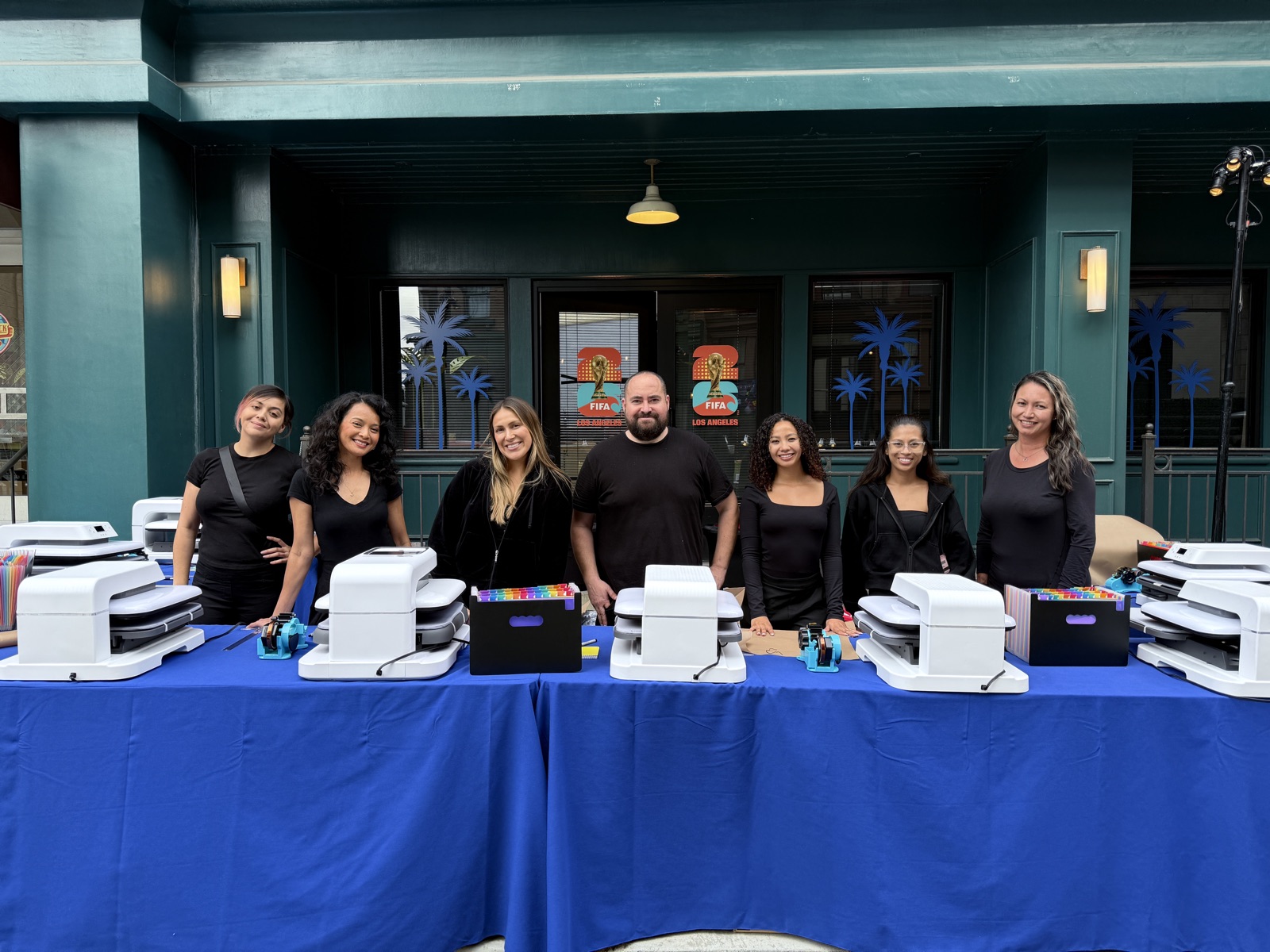
A heat press does not care about your run of show. It cares about three variables — temperature, dwell and pressure — and almost every blank on your table wants a different combination of them. Get it right and a guest wears the shirt for years. Get it wrong and the print peels in the first wash, which is a problem you hear about weeks later.
What follows is the field reference our crews work from. Treat it as a starting point, not gospel: heat press temperature and dwell settings for event fabrics shift with the film you run, the temperature of the room, and how honest your machine’s thermostat is being with you.
Start from the film spec, then adjust for fabric
Every DTF film and transfer type ships with a manufacturer spec sheet. That is your baseline. The fabric tells you which direction to move from it, and by how much.
Two things ruin more prints than bad numbers do. First, the digital readout reports the heating element, not the platen face where the garment sits — check it with an infrared thermometer or test strips at load-in, after lunch, and any time a press has sat idle. Second, ambient conditions move the number for you. An open dock, an unheated February tent or an aggressive HVAC vent pulls surface temperature down noticeably, and a press recovering from a cold cycle underperforms its own display for several minutes.
100% cotton: the forgiving one
Most DTF films land around 300–320°F for roughly 10–15 seconds at medium-firm pressure on ringspun cotton. It is the easiest fabric you will handle all day and the one to default to when a client asks what blank to pick.
Two habits beat fiddling with the dial. Pre-press the blank for three to five seconds to drive out moisture and flatten seam wrinkles — cotton out of a poly bag in a humid venue holds enough water to steam under the platen. Then post-press the finished piece under parchment; that is the step that makes the print survive washing.
Cotton scorches above the mid 330s. Garment-dyed and pigment-dyed pieces are the exception to all of this: the dye lightens where the platen touches, leaving a visible rectangle. Sacrifice one before you put a hundred on the table.
Polyester and performance wear: lower and faster
Polyester is where events go wrong. Disperse dyes begin to sublimate at temperatures well inside normal pressing range, then migrate into your white ink and reappear as a pink or rust haze twelve to forty-eight hours later. The shirt looks perfect when the guest walks away. It does not look perfect on Monday.
Drop the temperature meaningfully — the 270–285°F band is a common starting point — shorten the dwell and add pressure to compensate. If the event is poly-heavy, buy a low-temperature film rather than fighting a standard one. Cool the garment fast: rack it flat, never stack hot polyester, never bag it warm.
The honest advice nobody wants: if a client insists on a big white print on red, maroon or royal polyester, offer a blocker film or a different garment colour. Those migrate hardest, and no dwell time fixes chemistry.
Treat 50/50, 60/40 and tri-blends as polyester too. The rayon in a tri-blend is separately heat-sensitive and develops a permanent shine where the platen edge lands, so use a cover sheet and never re-press a spot hoping to fix a corner. Slub, heather and burnout fabrics have texture that stops adhesive making full contact — answer that with pressure and a thin foam pillow, not more heat.
Hats, nylon and awkward substrates
Hats need a curved cap press, not a flat platen and optimism. Structured six-panel fronts have buckram behind the fabric that dimples when pushed too hot, and foam-front truckers are more heat-sensitive again — both want lower temperature and shorter dwell than the tee beside them. For patches, tack for a few seconds, lift, confirm placement with the guest, then finish. A hat or patch bar turns about 30–45 pieces per hour per press and most of that is the guest deciding, so the extra step costs nothing. Leather scorches, chenille wants pressure rather than heat, and both get their own settings card.
Nylon totes, windbreakers and packable jackets are the usual day-of surprise, normally because someone added them late. Low heat, short dwell, real test press — coatings glaze or bubble and water-repellent finishes discolour. Buy a nylon-specific adhesive or a low-temperature film rather than improvising with a standard one.
Hardware is the other trap. Zippers, snaps, seams and webbing sit proud of the print area, so a flat platen presses air pockets and you get adhesion in two corners out of four. A press pillow slipped inside the garment lifts the print surface above the hardware and solves it in one move. Our notes on which products press cleanly at events are worth reading before you finalize the table.
Pressure, peel and the failures nobody catches
Pressure is the most-guessed variable in the room. On a clamshell, medium-firm is roughly where the handle needs two hands to start but closes without a fight. Re-check it after swapping platen pads or changing garment thickness.
Peel is film-specific and not negotiable. Peeling a cold-peel film hot lifts ink off in strings; peeling a hot-peel film cold leaves matte patches. Write the peel type on tape and stick it to the press.
Finally, power. Each press wants its own dedicated 20-amp circuit. Two sharing one line will trip a breaker mid-queue, and the real cost is not the downtime — it is the ten minutes afterward where the platen reads correct and presses cold. Confirm circuits at the walkthrough, not on the morning of the event.
Let us dial it in for you
If you would rather not own any of this, that is the job. Merch Troop brings calibrated presses, film matched to your blanks, and a crew that test-presses before doors. Send us your garment list and event date through our quote form or call (562) 614-4800, and we will tell you which pieces on that list are going to fight us — before you order them. Our planning guide covers the rest of the load-in.